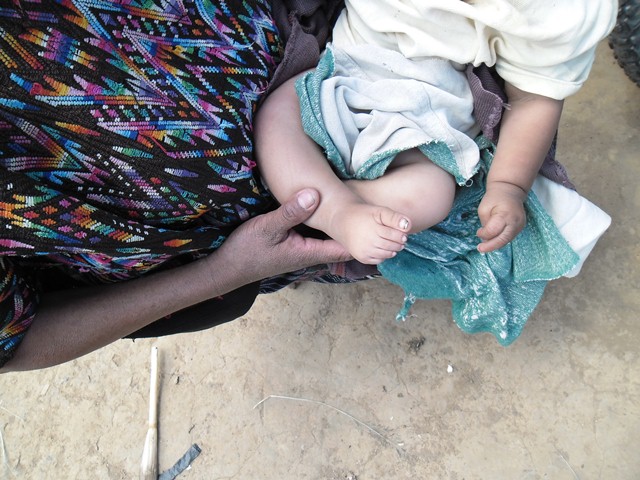
We thought this article was very interesting and very relevant to the overall purpose of Safe Homes for Children. Our goal is that any child who crosses our path will never find themselves in the situation of the little girl mentioned below. We aim to arm them with knowledge, health and power to keep themselves protected and in turn protect their future children.
Protecting girls from sexual exploitation in Guatemala
By Thomas Nybo
GUATEMALA CITY, Guatemala, 25 November 2008 – On the dark streets of
the capital city of Guatemala, away from the main thoroughfares, young
girls as sell their bodies for money. In hundreds of bars, brothels and
hotels across the city, an estimated 2,000 children are being sexually
exploited and the law has been doing little to protect them.
Many of the girls were sold into the sex trade by family members.
Others became desperate after being kicked out of their homes at a young
age. Children are vulnerable to sex traffickers who often lure them
with the promise conventional jobs that never materialize.
Once they have entered the sex trade, it is difficult for children to
escape. A formidable combination of poverty, substance abuse and
accumulated debt often leaves them feeling trapped and with few
alternatives.
‘That’s how it started’
Ana María (not her real name) was abandoned by her mother at the age
of six. She lived for years on the street, struggling with drug and
alcohol addiction. Feeling hopeless, she took a job as a sex worker in a
night club.
“I met a man when I was nine-and-a-half years old,” says Ana Maria,
who is now 17. “He worked at a night club and he took me with him –
that's how it started.”
Ana María was forced to work in a filthy brothel, where the woman in
charge deducted inflated expenses to supposedly cover room and board. By
the end of the month, after expenses, she had little to show for her
work. Eventually, Ana María returned to the street.
Legislation to protect children
Her situation is all too common in Guatemala, a country with no serious laws against the sexual exploitation of children.
“Globally, children's sexual exploitation is considered a serious
crime, condemned beyond national borders. Nevertheless, in Guatemala it
is not considered a crime. The traffickers are sanctioned with a small
fine” says UNICEF Representative Adriano González-Regueral.
Too often, the child victims of sex crimes here are labeled by
society as the criminals, while the adult perpetrators walk free.
UNICEF is working to get legislation enacted – and enforced - that will
finally offer protection to girls like Ana María. But the legislative
gears grind slowly in Guatemala. The most serious and complete of the
proposed laws was presented to congress in August: 'The Law Against
Sexual Violence, Exploitation and Trafficking'.
“UNICEF is working with the tourism industry, with academics, with
the government and with civil society to build awareness about what
constitutes sexual exploitation, where it can be found and what can be
done to stop it,” says UNICEF Guatemala Child Protection Specialist
Justo Solorzano.
A long way to go
For the past five months, Ana Maria has been under the care of Casa
Alianza Guatemala, a UNICEF supported organization that protects
children in need, especially those who have suffered physical and
psychological abuse. The goal is to integrate the children back into
mainstream society, preferably with their families whenever possible.
“Casa Alianza started working in Guatemala 27 years ago,” said
Executive Director of Casa Alianza Guatemala Claudia Rivera. “We have
several programs to work in prevention, to work at the streets directly.
And we also have a program that looks for justice at the court for the
children.”
The road ahead for girls like Ana Maria is difficult. She's been free
of drugs and alcohol for many months, and she's already received basic
vocational training. But she feels she still has a long way to go.
“I don't think I'll return to the sex trade,” she says, now hopeful
for her future. “I want to give my daughters a good example. I feel
strongly that I don't want my girls to go the same direction that I
did.”